Carmilla
A History of the Vampire in Popular CultureIdentity and Literary Background
Carmilla first appeared in Sheridan Le Fanu’s novella published in 1872, a work originally serialised in the London literary magazine The Dark Blue from late 1871 to March 1872. The book belongs to the period when older stories of the undead were being reshaped into the recognisable modern vampire. Earlier traditions included Lamia, Astryiah, the impundulu, revenants, and the baobhan sith, but Carmilla helped move the figure away from the merely ugly or corpse-like bloodsucker and toward a more selective, elegant, psychologically charged predator. In this transformation, she stands beside Varney, whose 1845 penny-dreadful series introduced sharpened, fang-like teeth and even made its murderous monster partly sympathetic, while Carmilla more directly established the literary pattern of the beautiful night creature who combines feeding with emotional manipulation.
Carmilla’s identity is deliberately unstable. She is known as Carmilla, appears in the related forms of Millarca and Mircalla, and is finally identified with Mircalla, the vampiric figure associated with the nearby town of Karnstein. The names are not incidental clues: Millarca is an anagram of Carmilla, and the repeated identities allow her to move through different households and relationships while concealing the continuity of her predation. Her aliases also make recognition a narrative process. The danger is present before it can be named, and the eventual discovery that the apparently separate women are one being converts scattered unease into a coherent supernatural history.
Entry into Laura’s World
Carmilla is left to stay with a widow and his daughter Laura, a household whose kindness and gullibility make it vulnerable to a carefully presented stranger. Laura is particularly receptive to the new lodger because her closest friend has died under mysterious circumstances, leaving her isolated and grateful for companionship. Carmilla therefore enters the story not simply as an invader but as an answer to an emotional absence. Her presence supplies intimacy at the same moment that it conceals the mechanism of her feeding.
The connection between Carmilla and Laura is marked by a romantically entwined fate from the beginning. Both girls had recognised each other in a dream during childhood, and a restored painting of Laura’s ancestor Mircalla bears a striking resemblance to Carmilla. The portrait gives the relationship a visual and genealogical echo: the visitor resembles a woman from the family’s past, while the shared dream suggests that their meeting has been anticipated long before either can understand it. Recognition thus precedes explanation, and attraction arrives before the household possesses the knowledge needed to defend itself.
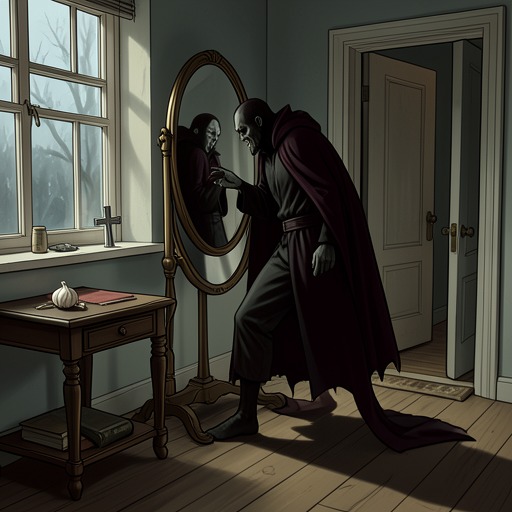
Her behaviour makes the contrast between companionship and predation increasingly difficult to ignore. Carmilla sleeps through the day, spends the night apparently sleepwalking, and occasionally makes romantic overtures toward Laura. She also avoids joining the family in prayer, a conspicuous violation in the early nineteenth-century setting and a sign that places her outside the household’s religious and moral order. These habits establish the central rhythm of her character: daylight withdrawal, nocturnal movement, erotic closeness, and resistance to the rituals by which the living community defines itself.
Predation, Recognition, and Destruction
The truth about Carmilla emerges through a second story of apparent friendship. Laura and her father travel without Carmilla and meet General Spielsdorf, the uncle of Laura’s late friend Bertha. He explains that Bertha had befriended a young woman named Millarca shortly before her death. Millarca had arrived under circumstances almost identical to those surrounding Carmilla’s arrival at Laura’s home. The recurrence of the same pattern reveals Carmilla’s method: she enters an isolated household under an attractive identity, establishes emotional trust, and leaves death behind her when the relationship has run its course.
The recognition that Carmilla, Millarca, and Mircalla are one and the same turns the investigation toward the past. Laura, her father, and General Spielsdorf travel to Karnstein to locate Mircalla’s tomb so that the General can end her existence permanently. Carmilla appears when the General and Laura are alone and reacts with rage, again evading the General’s attempts to kill her. Her anger is not a collapse of the seductive persona so much as its violent underside: the guest who once entered through intimacy now confronts the household through open resistance.
The final destruction is carried out by Baron Vordenburg, who joins the group and destroys the vampiric Mircalla. The ending restores a boundary between the living household and the undead intruder, but it does not erase the emotional force of what came before. Carmilla’s defeat follows identification, pursuit, and the recovery of her buried name. The narrative therefore treats knowledge as a practical weapon: only when the aliases are connected, the repeated attacks recognised, and the tomb located can the predator be expelled.
Desire, Otherness, and Adaptation
Carmilla was an openly gay woman long before lesbianism was regularly acknowledged in public, and the novella’s power comes partly from the way it joins same-sex desire to supernatural danger. The text does not offer a simple social portrait of an ordinary relationship; Carmilla’s intimacy is also a predatory act, and Laura’s attraction exists within a structure of vulnerability. Yet the combination of romantic overture, emotional dependence, secrecy, and bloodletting gives the vampire a significance beyond physical horror. She becomes a figure through whom a nineteenth-century audience could encounter desires that respectable society found difficult to name, while preserving the protective distance of monstrosity.
This pattern places Carmilla within the broader history of the vampire as a metaphor for forbidden passion. Later accounts describe Lord Ruthven, Carmilla, and Count Dracula as figures who captured the imagination of an outwardly prim nineteenth-century society because they allowed desire to appear as supernatural compulsion. The threatened woman could be imagined as seduced by a force more powerful than herself, gaining an excuse for conduct that would otherwise invite moral judgment. Carmilla intensifies that structure by making the seducer female and by directing the emotional charge toward Laura rather than toward a conventional male-female romance.
The character’s afterlife in film shows how readily her pattern could be adapted to changing ideas about sexuality. Vampire Lovers, directed by Roy Ward Baker in 1970, retained the central characters while casting Ingrid Pitt as Marcilla, Carmilla, and Mircalla. In that version, Marcilla’s mother leaves her in the care of General Spielsdorf and his daughter Laura; Marcilla seduces the innocent Laura and gradually drains her of life, then leaves after Laura’s death and moves in on Emma, whose governess becomes her willing accomplice. The film was produced by Hammer Film Productions and American International during a period of relaxed film censorship and changing public attitudes toward on-screen sexuality. Although it included nudity, its treatment was described as tame by modern standards and retained an oddly innocent atmosphere alongside its blood-and-bodies imagery.
Enduring Genre Significance
Carmilla’s decisive contribution to vampire fiction is the fusion of predation with elegance, selectivity, and intimate psychological pressure. The vampire is no longer only an ugly corpse or a restless revenant; she sleeps by day, prowls by night, chooses particular victims, enters through trust, and makes the act of feeding inseparable from the language of attraction. That development helped prepare the ground for the later Count Dracula, whose fully rounded personality, deliberate plans, and moral complexity made him the most influential vampire in popular culture, as well as for subsequent sympathetic, erotic, comic, and openly modern vampires.
Her influence also persists because later vampire fiction repeatedly reworks the question of whether monstrosity and identity can be separated. Modern vampires may be good or bad, hidden or openly integrated, traditional or radically unconventional. Yet the central possibility that Carmilla embodies remains stable: the monster may be frightening precisely because the victim wants proximity to it. In that sense, Carmilla is both a historical character and a recurring genre mechanism, converting the boundary between affection and consumption into the story’s most unsettling source of power.